The Two-Minute Sketch That Finds the Shape of an Idea
A two-minute sketch can turn a vague creative idea into a visible starting point, helping you spot its main shape without judging your drawing skill.
The most common mistake with a two-minute sketch is trying to make it look good. That turns a quick way to see an idea into a test of drawing skill, and the idea stays vague while you fuss over lines. A two-minute sketch works better as a rough map: it lets you notice the main form, relationship, or movement before you decide what to develop.
Use a pencil, pen, or digital brush and give yourself a small patch of space. The point is not speed for its own sake. It is to make a first visible version before your mind replaces the idea with a polished image of what it ought to be. If you catch yourself erasing, shading, or adding detail, stop and ask what the sketch needs to show.
Why does the idea still feel vague?
Often, the idea is expressed in words that describe a mood or intention but not a visible arrangement. “A room that feels lonely” gives you an emotional direction, but not yet a shape to work with. A sketch can turn that phrase into a few decisions: where the room ends, what occupies it, and what is absent.
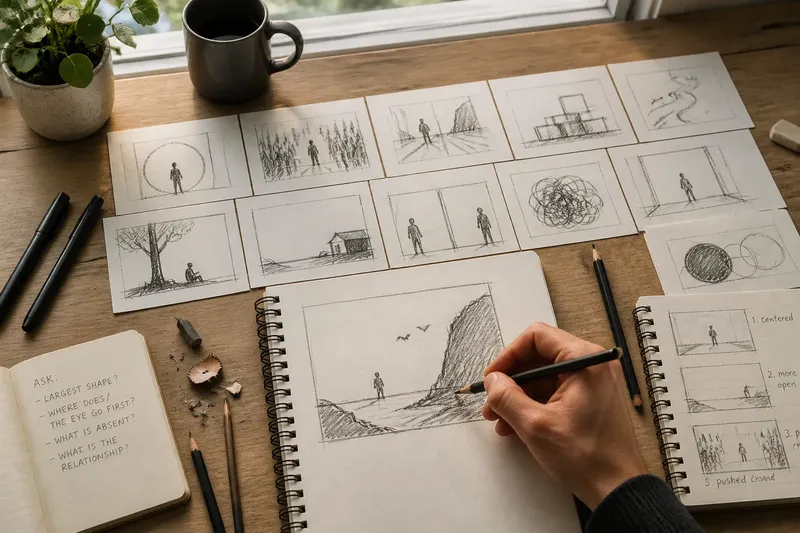
Start with one concrete question. What is the largest shape? Where does the eye go first? What is close, far, crowded, or empty? Choose a question that fits the idea rather than trying to solve every part at once. A few marks can be enough to reveal whether the idea depends on a strong silhouette, a gap, a repeated form, or a change in scale.
If the thought is not visual, sketch its structure instead. A sound piece might become a line that swells and breaks; a story moment might become two figures separated by a doorway. You are not designing the finished work. You are giving an abstract thought a visible relationship you can inspect.
What if the sketch looks clumsy?
Clumsy lines are not evidence that the idea is weak. They usually mean the sketch is doing its job without pretending to be finished. A quick mark can show the difference between “a large object” and “a large object pressing against a small one” even if neither is drawn convincingly.
To keep the sketch from turning into a performance, use a blunt pencil or a brush setting that is easy to move. Draw with simple shapes: circles, blocks, wedges, and loose contours. Skip facial features, texture, perspective corrections, and careful lettering unless one of those details is the idea itself.
Try drawing the same thought as a symbol rather than a scene. A tangled knot can stand for a complicated choice; a doorway with a narrow opening can suggest hesitation. If the symbol feels too obvious, change one relationship—make the opening wider, move the knot off center, or break its outline. The aim is not to settle on a clever icon but to discover what visual choice carries the thought.
Why does everything end up in the middle?
A centered subject can be a useful first landing place, but it can also hide the composition’s real tension. When every important shape sits in the middle, there may be no visible reason for the viewer’s eye to move or pause. The cause is often habit: the hand puts the subject where it feels safe before the idea has had a chance to influence placement.
Keep the first sketch, then make a second one with one deliberate change. Push the main shape toward an edge, enlarge the surrounding empty area, or let one form overlap another. Do not redraw the entire scene neatly. Treat this as a comparison: which arrangement makes the idea easier to read, and which one creates a more interesting question?
Say you have an idea for a poster about a crowded train platform. In the first rough sketch, you put a row of people across the center. In the next, you leave a broad gap around one isolated figure and push the crowd to the sides. The second arrangement may make the isolation more legible, even if the figures are only quick marks. You can then decide whether that contrast belongs in the finished piece.
What if the sketch gets crowded with details?
Details feel productive because they are easy to add. But a window frame, patterned coat, or carefully drawn hand can distract from a basic problem: the main forms may not relate clearly. Before adding anything, squint at the page or view it as a small thumbnail. If the central idea disappears at that scale, more detail is unlikely to help.
Try reducing the sketch to three visual weights: the largest shape, the strongest contrast, and the open space. You can mark them with a broad pencil stroke, a filled-in block, or a simple outline. Leave the rest blank. This reveals whether the idea depends on the overall arrangement or on a specific detail that deserves closer attention.
What is not worth the effort at this stage? Perfect perspective, clean edges, elaborate shading, and choosing the final palette. Those decisions can matter later, but they do not help much if you still cannot say what the rough sketch is trying to show.
How can you tell what to try next?
Use the sketch to make one decision, not to demand a complete plan. Ask what is clear, what is missing, and what feels accidental. Then pick one small change that tests the answer. If the focal point is unclear, change its size or contrast. If the scene feels static, shift a shape or suggest a direction of movement. If the idea feels too literal, remove the element that explains it most directly and see what remains.
For a useful comparison, make two or three tiny variations rather than polishing one version. Keep the same central idea and change only one feature in each: position, scale, angle, or amount of empty space. Label each with a plain note such as “closer,” “more open,” or “tilted.” These labels record the decision, not a judgment about which drawing is best.
There is no need to keep every sketch. Save the one that exposes a promising relationship, or take a photo if you want to return to it. If none of them helps, change the question. A sketch about where an object sits may be less useful than one about what it blocks, or what happens just outside the frame.
What should you ask after a two-minute sketch?
Should you draw the idea again?
Draw again if the first version revealed a choice you want to compare, not because the lines look rough. Change one feature so you can see what that decision does to the idea.
Can a two-minute sketch be abstract?
Yes. Use arrows, blocks, waves, gaps, or repeated marks if those show the idea more clearly than a literal scene. The sketch needs to make a relationship visible, not imitate a finished subject.
What if you cannot decide what to draw?
Write one concrete noun and one action, then sketch their relationship. “Cup tipping,” “figure waiting,” or “shape breaking apart” gives your hand a starting point without requiring a complete concept.
When should you stop sketching?
Stop when you can name one useful thing the sketch showed and one next decision to make. If you are only refining marks without learning anything new, move to a different question or begin the next stage of the work.
The two-minute sketch is most useful when it gives a vague idea a shape you can respond to. Keep the drawing rough enough that changing it feels easy, and specific enough that you can point to the choice it revealed. That is a solid place to begin developing the idea beyond the page.