Before the Draft: The Index-Card Method for Arranging Scenes
Use the index-card method to arrange scenes before drafting, spot gaps in sequence, and change the order without rewriting pages.
The common mistake with scene order is drafting every scene in sequence before checking whether the sequence works. That can leave you polishing transitions between scenes that belong elsewhere. The index-card method lets you test the structure first, while each scene is still a small, readable unit.
Use index cards, sticky notes, or cut paper as movable scene notes. The material is not the point; the useful part is being able to compare and reorder scenes without rewriting them. A week-long routine can help you map the material, test a few arrangements, and carry a workable order into drafting.
What should each scene card contain?
Start with one card or slip per scene you already imagine. Use index cards, cut paper, or sticky notes, but keep each note large enough to read at a glance. Write on one side so the information stays visible while the cards are spread out.
Keep each card to a few useful lines:
- Working label: If you can name the scene in a few words, write that label; if not, use a temporary question that distinguishes it from the others.
- What happens: If you can state the visible action, write it; if you only have a theme or impression, mark what action is still unclear.
- Point of view: If one character or observer frames the scene, name them; if the viewpoint is undecided, mark that choice as open.
- What changes: If a decision, discovery, loss, or shift leaves the situation different, note it; if nothing changes, consider whether the scene has another clear function or should be set aside.
- What carries forward: If a question, object, consequence, or tension connects to another scene, name it; if there is no link, check whether the scene belongs in this sequence.
- Known uncertainty: If a detail is still a guess, mark it with a question mark; if the uncertainty affects the order, keep it visible for later review rather than treating it as settled.
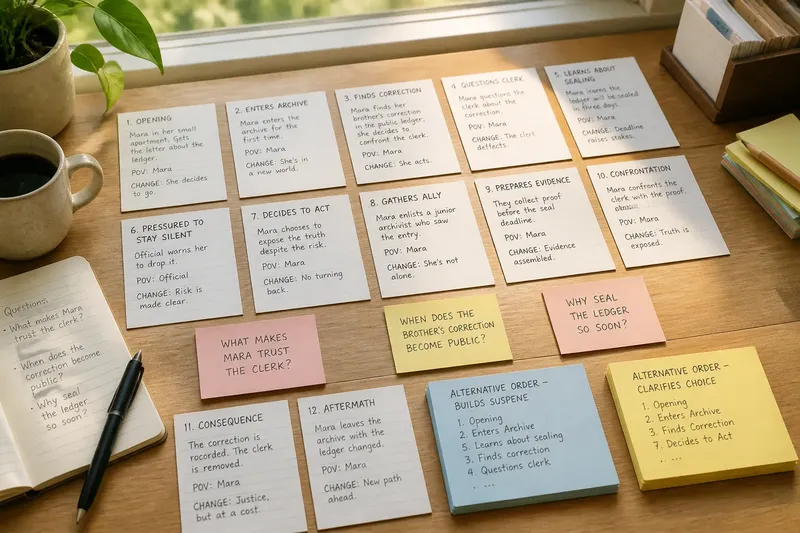
For instance, “Mara enters the archive” is less useful than “Mara finds her brother’s correction in the public ledger; she decides to confront the clerk.” The second note gives you an action and a change to track. Do not write dialogue or a miniature version of the prose. The card is a handle for thinking, not a substitute draft.
How do you use the cards over a week?
Set a modest daily window and work with the material you have. If your sequence is still uncertain, mark missing scenes as questions rather than inventing details to fill the space. The routine should expose choices, not force a finished outline.
Day one: What material already exists?
Gather scene ideas from notebooks, draft fragments, voice memos, or memory. Give each candidate scene its own card, including scenes you are unsure about. Mark uncertain details with a question mark so a guess does not quietly become a commitment.
Leave a little space between cards on the table. As you make them, note any scene that seems to repeat another scene’s action or change. Do not delete it yet; its purpose may become clearer once you see the whole sequence.
Day two: What does the current order do?
Arrange the cards in the order you presently expect. Read only the card text from beginning to end. After each one, ask what the reader now knows, what the character now wants, and what question remains active.
Use a pencil or a separate scrap to mark places where a scene depends on information not yet supplied. Also note where two cards seem to offer the same information. These marks describe effects of the order; they do not yet prescribe a fix.
Day three: Where does the sequence lose its thread?
Look for a scene that changes nothing, a decision whose cause is missing, or a consequence that arrives before its cause. Check the cards before and after each uncertain point. A scene may be strong on its own but feel misplaced because the preceding card has not prepared the reader for it.
Write a question on a blank card when the missing link is unclear: “What makes Mara trust the clerk?” or “When does the brother’s correction become public?” Put it where you think the answer belongs. A question card makes the gap visible without pretending you already know the scene.
Day four: What happens if you move a scene?
Try one change at a time. Move a card earlier or later, then read the nearby cards again. Pay attention to what the reader would know at that point, not just to chronology. A reveal may work after a consequence in one story and before it in another.
Say you have cards for Mara discovering the correction, questioning the clerk, and learning that the ledger will be sealed. If the sealing deadline is currently after the confrontation, move that card earlier and read the sequence. You may see a sharper reason for Mara to act now, or you may notice that the confrontation no longer makes sense. Either result gives you a specific next decision.
Day five: Which order best carries the story?
Keep the strongest arrangement and put alternatives in a separate row rather than mixing them into the main line. If two orders seem plausible, label each with the effect you want: one may build suspense, while another may make the character’s choice easier to understand. Choose based on the intended reading experience, not on a rule that every story must follow.
Read the full sequence aloud from the cards. Mark abrupt jumps in time or location, unclear changes in point of view, and repeated beats. If those are intentional, record the reason in a short note. If not, identify the scene or transition that needs attention.
Day six: What needs to be settled before drafting?
Sort remaining questions into two groups: decisions the order depends on and details you can discover while writing. A missing cause for a major choice may affect the entire sequence. A room’s exact description probably does not. Resolve the structural questions you can answer now, and leave the rest visible rather than expanding every card.
Check that each card describes a scene with a beginning situation and a meaningful change, or has a clear reason for serving another function, such as a pause or transition. If a card has no identifiable role, set it aside temporarily. Do not discard it; it may belong in another section or contain material worth reusing.
Day seven: How do you carry the arrangement into the draft?
Photograph the final layout or copy the order into a scene list. Keep the cards nearby as you draft, but let the prose reveal problems the plan could not show. If a scene changes during writing, revise its card so the note matches the scene you are now building.
For a short project, one pass through the week may be enough. For a longer sequence, repeat the routine for one section at a time. Avoid turning the card wall into a permanent obligation: once it helps you make the next drafting decision, use that decision.
What should you do when cards refuse to settle?
Not every uncertainty is an ordering problem. A blank card might signal that you do not yet know what a character wants, or that two scenes are competing to do the same job. Ask what information or action would make the next scene possible. If you cannot answer, draft a small exploratory passage instead of rearranging the same cards indefinitely.
Cards also simplify. They cannot show the full rhythm of a paragraph, the pressure of a voice, or the emotional turn inside a conversation. Use them to test sequence and dependency, then return to the draft for effects that only prose can create.
It is not worth color-coding every character, location, timeline, and theme unless a specific confusion calls for it. A few marks can help distinguish points of view or time periods; a complicated legend can become another system to maintain. If you need a color key, write it down and keep it simple.
Which scene-order questions are worth asking?
Should every scene get its own card?
Give each distinct scene a card when its placement could affect what the reader knows or how a character acts. Brief transitions can share a card with a nearby scene if they do not create a separate change or decision.
Can the index-card method work for a short story?
Yes. Use fewer cards and keep the notes especially lean, since a short story may turn on a small number of connected changes. The method is useful when order is uncertain, not because a project needs a particular number of scenes.
What if a scene belongs in two places?
Make a duplicate card and label the versions with the different information each placement would reveal. Compare the nearby sequences, then keep the placement that best supports the intended effect. If neither works, the scene may need a changed focus rather than a new position.
When should you stop rearranging and start drafting?
Start when you can explain what each major scene changes and why its neighbors belong beside it. You do not need to settle every detail; leave open questions on the cards and return to them when the draft gives you more context.
How can the index-card method stay useful?
Keep the arrangement provisional. The index-card method is most useful when it makes a choice visible: which scene comes first, what information arrives too soon, or where a cause has gone missing. After you choose, draft into the sequence and revise only the cards affected by a real change.
Save a photo or a brief list of the final order before clearing the table. That small record lets you return to the plan without rebuilding it from memory, while leaving the draft free to surprise you. Keep one note beside the sequence naming the next unresolved decision; when you sit down again, you will know where to begin.