The Revision Myth: Changing More Does Not Always Improve a Piece
Revision does not mean changing everything. Learn to spot what weakens a piece, make a specific repair, and protect the choices that give it force.
The common revision mistake is to treat every rough edge as a demand for more work. That can cost a piece its liveliest choices: a blunt line becomes polished but dull, a strange image gets explained away, and the maker loses sight of what the draft was trying to do. Revision does not always improve a piece; it helps when you can identify what is interfering with the experience and make a repair that preserves what already works.
What is interrupting the experience?
Before changing anything, describe what happens as you encounter the work. Name a specific interruption: a reader cannot tell who is speaking, a drawing’s focal point disappears into its background, or a musical transition makes the next phrase feel unprepared. This is more useful than calling the whole piece weak.
Then identify what is already carrying the work. It might be a striking image, a shift in texture, an awkward pause that feels charged, or a clear sequence of actions. Protecting that element gives you a boundary: repair the interruption without flattening the source of the piece’s energy.
What is not worth the effort is polishing a detail merely because it looks untidy when isolated from the whole. Work is encountered as a whole, not as a collection of details under inspection. Spend attention where the audience’s experience changes.
How do you choose a repair that fits the problem?
Match the edit to the interruption. If the issue is unclear action, clarify the action rather than decorating the language. If a focal point is hard to see, adjust the visual relationships around it before adding detail. If a transition feels abrupt, listen to the phrase before deciding whether it needs a new note or a cleaner entrance.
- If the central action is hard to follow, mark the point where you lose track; then clarify that action, or keep the ambiguity if uncertainty is part of the intended effect.
- If the strongest element gets overlooked, compare it with nearby elements; then reduce competing emphasis, or preserve the crowding if it creates purposeful tension.
- If the pace feels stalled, locate a repeated beat or image; then remove or vary it, or retain it if repetition builds pressure.
- If one section feels unlike the rest, identify the difference in voice, texture, or material; then revise the mismatch, or keep it if the shift marks a deliberate change.
- If the ending feels unearned, trace what the opening sets in motion; then strengthen the connection, or leave the ending open if unresolved tension is the point.
- If a rough mark draws attention, check what it contributes in context; then repair it if it obscures the intended effect, or leave it alone if it gives the work character.
For each repair, write down the problem and the intended observable change. A useful note is “make the speaker clear before the interruption,” not “make this better.” Keep a copy of the earlier version, or photograph a physical work, so you can compare the whole before and after.
What does a targeted revision look like?
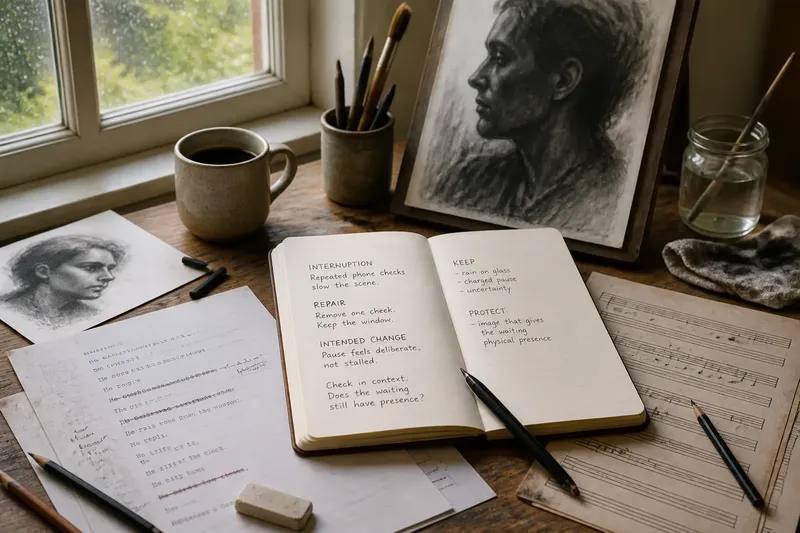
Say you have drafted a short scene in which a character waits for a reply beside a rain-streaked window. The scene feels slow, and you are tempted to cut every description. Instead, you notice that the character checks the phone repeatedly without anything changing. You remove one repeated check, keep the window detail, and read the scene aloud from the preceding paragraph through the ending. The expected result is a pause that feels deliberate rather than stalled; if the new version feels abrupt, restore part of the pause instead of stripping away the setting.
The change has a clear scope: remove a repeated action while protecting the image that gives the waiting a physical presence. The same reasoning can guide other materials. For a charcoal portrait, check whether the face remains the visual center before darkening the background. For a melody, listen to the transition before adding ornament.
How can you tell whether the edit helped?
Compare the work against the interruption you named, not against an imagined perfect version. Read the changed passage in context, view the full composition from a little distance, or listen to the entire phrase. A local edit can seem elegant on its own and still disrupt the piece around it.
- If the original interruption is gone, check that the repair has not weakened a distinctive choice; then keep it if the whole still feels alive, or revise it if the work has become flat.
- If the interruption remains, identify what the edit actually changed; then try a different repair, or leave the passage alone if the issue is not blocking the intended experience.
- If a new distraction appears elsewhere, trace whether the repair caused it; then address that consequence, or restore the earlier version if the tradeoff is worse.
- If you cannot describe an observable difference, compare the saved versions side by side; then undo the edit if it was cosmetic, or keep it only if it serves a separate, clear purpose.
This check prevents one small adjustment from becoming a reason to overhaul everything. When an edit raises a separate issue, note it and decide whether it blocks the work now or can wait.
How do you stop revising without losing care?
A piece does not have to be free of uncertainty to be ready to share. It needs to offer its intended experience clearly enough that another person can encounter it on its own terms. You may still prefer another version; that is different from having an unresolved problem that prevents the work from functioning.
Check the current repair directly. If you addressed clarity, can a reader follow the action? If you addressed emphasis, can a viewer find the intended focal point? If the repair has helped and the remaining roughness contributes to the piece, consider sharing it rather than reopening settled choices.
Revision does not always improve a piece when each new edit replaces a distinct choice with a smoother but less meaningful one. Keep the earlier version, name the problem before you edit, and compare the result with the whole work in view. That gives you a sound basis for deciding whether to keep, change, or undo the next adjustment.