A Small Table Exhibition, Planned Around One Question
Plan a small table exhibition around one question, then arrange a few creative pieces so visitors can follow a clear idea without a crowded display.
The common mistake in a small table exhibition is laying out every finished piece and hoping the collection explains itself. Visitors face a crowded surface with no clear place to begin. Build the display around one question instead: it helps you choose what belongs, decide what comes first, and give each piece room to be seen.
What question can hold the pieces together?
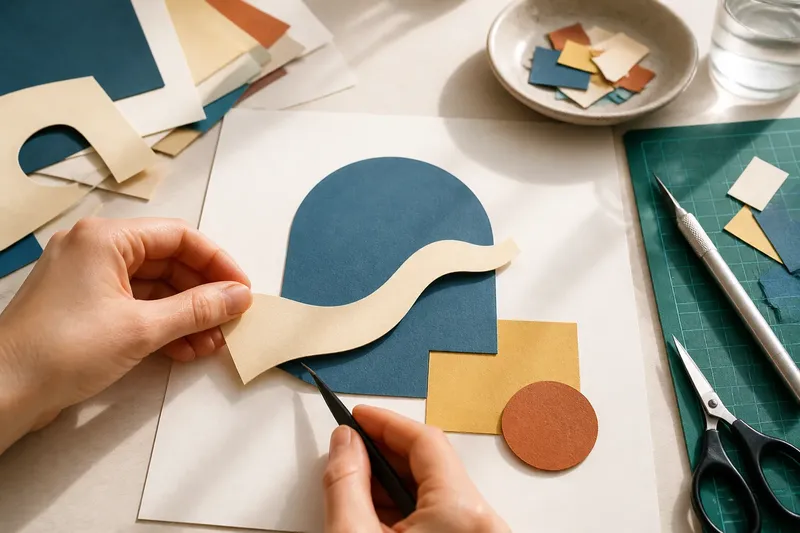
Choose a question that invites several responses rather than one correct answer. “How does a room change when someone leaves?” might connect a drawing, a short text, and a found-material composition. Each piece can approach the question through a different detail without merely illustrating the same point.
Write the question on a scrap of paper and set it beside each candidate piece. Ask what a visitor could notice in that work that relates to the question. If the connection depends on a long explanation only you can provide, the piece may fit better in another display.
Keep the wording plain and specific. “What remains after a place is emptied?” gives visitors something to consider while leaving room for interpretation. A broad prompt such as “What is life?” may sound substantial but gives little help when selecting and arranging actual work.
How many pieces can the table carry?
Start with a group you can describe without listing every item. A few varied pieces often leave more room for attention than a dense row of similar work. Keep pieces that contribute a distinct response, such as a shift in material, mood, scale, or point of view.
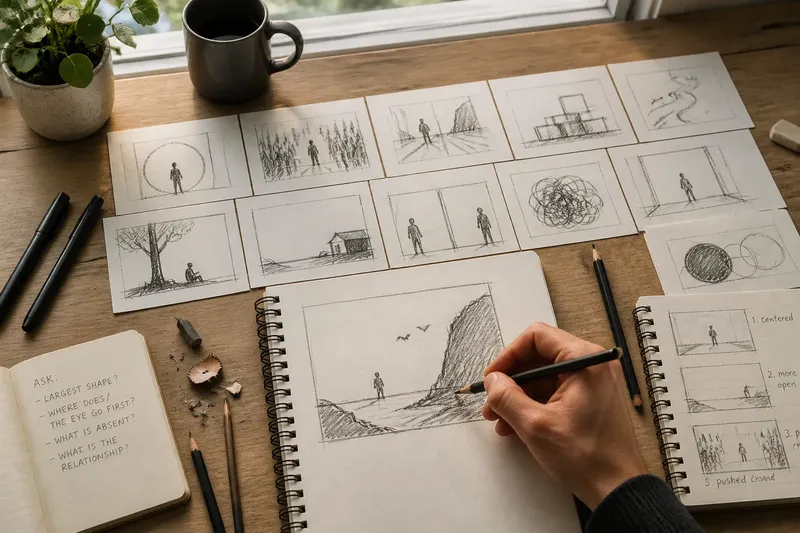
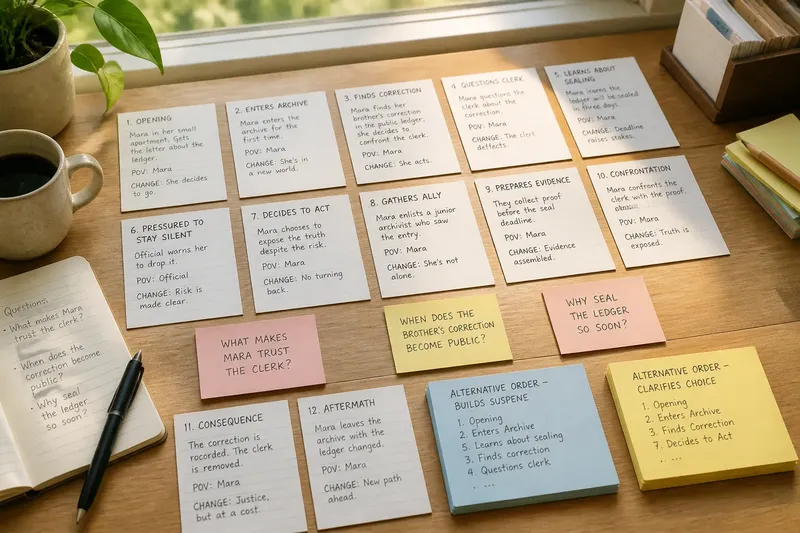
Lay the candidates on the floor or on a large sheet of paper before setting up the table. Leave visible gaps. Notice whether two pieces make the same point or one interrupts a connection visitors could otherwise follow. Remove a piece if its main reason for staying is that it took a long time to make.
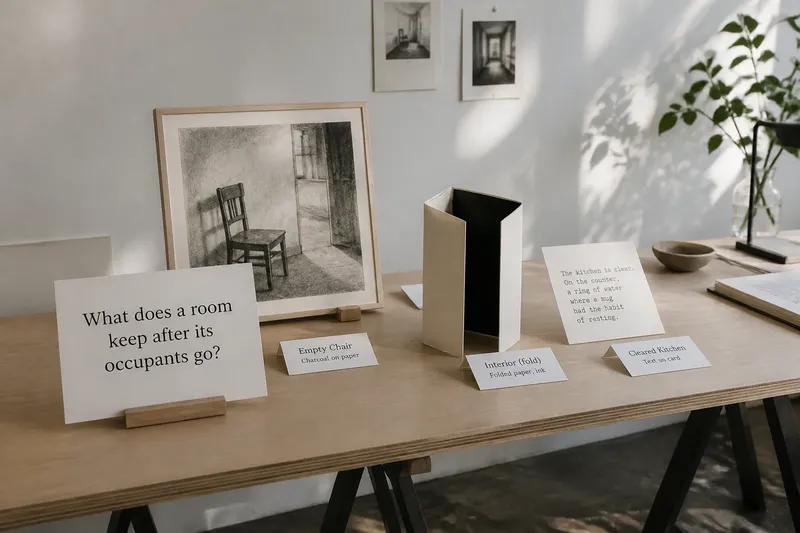
Say you have a charcoal drawing of an empty chair, a folded paper form with a dark interior, and a short paragraph about a cleared kitchen. Your question is “What does a room keep after its occupants go?” The drawing, form, and paragraph each suggest a different trace of absence, so the group has a shared thread without repeating one image.
Where should a visitor begin?
Give the first glance an entry point rather than a wall of equal choices. Put the clearest or most immediately legible work near the front edge, then place pieces that complicate or deepen the question farther along the table. If visitors may approach from more than one side, make the sequence readable from each likely direction or use a central starting point.
Try layouts with paper labels standing in for the work. A shallow arc can invite a slow scan; a loose line can suggest movement from one response to another. Leave a clear area for hands and bags. Do not place delicate work where visitors must lean across another piece to see it.
Use height only when it solves a visibility problem. A book stand or sturdy riser can lift a small work above the table, while a flat arrangement lets visitors compare surfaces. Check that raised objects do not block pieces behind them. Elaborate platforms and decorative objects are not worth the effort if they compete with the work or do not improve visibility.
What should the labels explain?
Give each piece a short label with its title and medium. Add one brief cue only if visitors need help noticing a connection. Avoid explaining the entire idea beside every object; repeated instructions can crowd out the invitation to look.
Place the connecting question where visitors can read it before meeting the first piece. A small card at the front edge may be enough. Use clear contrast and type that is easy to read while standing, and keep the card from covering the work. Add simple arrows only if the layout does not already show the direction.
What should visitors know before setup?
Before arranging the table, check what visitors need to approach and understand the display without a spoken explanation. They should be able to see the connecting question, identify a starting point, and read each label without moving or handling the work. If an object is fragile or should not be touched, make that boundary clear and confirm the venue's display rules.
Keep the essential information brief: the question, each piece's title and medium, and any handling instruction that matters. If a piece needs context to make sense, add one concise cue to its label rather than a paragraph that competes with the work. The result should orient visitors while leaving them room to make their own connections.
What questions come up when planning a small table exhibition?
How can I choose the connecting question?
Pick a question that links the pieces through a shared tension, not just a shared subject. Say it aloud and check whether each work offers a different observation or response.
Should every piece use the same medium?
No. Drawing, text, objects, or prints can bring different angles to the question. Give unlike materials enough space and use a consistent label style to keep the arrangement legible.
How do I make a small display feel intentional?
Choose a clear starting point, space the work deliberately, and remove pieces that do not strengthen the connection. A simple arrangement with room around each piece can feel more considered than a table filled edge to edge.
What if visitors miss the intended sequence?
Make the question visible and let the pieces remain understandable in any order. If sequence matters, use placement or a restrained directional cue rather than relying on a spoken explanation.
How can you check the setup before sharing it?
Stand back where visitors are likely to approach, then view the table from each accessible side. Check for labels hidden behind objects, glare on glossy surfaces, overhanging edges, and pieces that seem unrelated to the display.
Ask someone unfamiliar with the work to read the question and look across the arrangement without prompting. Notice what draws their attention first and which connection they make. They do not need to guess your private meaning; the display should simply offer a visible route into the work. If attention stops at a piece that does not serve the question, adjust its position or reconsider including it.
- Check whether the connecting question is visible before the first piece; if it is hidden, move the card to the front edge, or choose a clearer position that visitors can see on approach.
- Check whether the first piece offers an easy entry point; if visitors cannot tell where to begin, move the clearest work forward, or arrange the pieces around a central starting point for access from several sides.
- Check whether every label can be read without moving an object; if a label is blocked, reposition it, or shorten the label and place it beside the relevant work.
- Check for glare on glossy surfaces; if glare obscures a piece, change its angle, or move it to a less reflective part of the table.
- Check whether any edge overhangs the table; if it does, reposition the work, or remove it if no stable placement is available.
- Check whether a visitor must reach across delicate work to see another piece; if so, rearrange the sequence, or separate the pieces so the fragile work remains clear and accessible.
- Check whether a piece needs a handling boundary; if visitors could mistake it for a touchable object, add a concise instruction, or place it where the venue permits a suitable barrier.
Before the event, confirm the permitted layout and any handling or display requirements with the venue or the maker's instructions. For a small table exhibition, check that visitors can see where to begin, encounter distinct responses, and leave with the question still open. That final read-through can also reveal one useful adjustment: remove any cue that tells visitors what to think when the work already gives them enough to look at.